



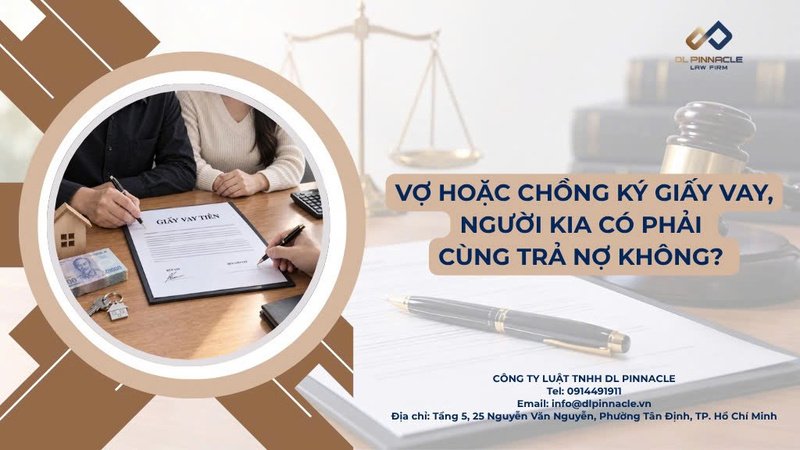
When One Spouse Signs a Loan Agreement, Is the Other Liable to Repay?
 Luật sư: Nguyễn Bá Tùng
 Cập nhật: 10:31, Thứ Tư 30/09/2026
An analysis of joint and separate spousal liabilities under the 2014 Law on Marriage and Family, key criteria for joint liability, and the burden of proof when only one spouse signs a loan agreement.
Index
I. Principles for determining spousal property obligations:
II. Are spouses jointly liable when only one spouse enters into a loan transaction?
2.1. Loans established by one spouse deemed joint property obligations:
2.2. Loans established by one spouse deemed separate property obligations:
In marital and family life, it is quite common for one spouse to enter into a loan transaction to cover living expenses, invest, conduct family business, or serve other purposes. However, in practice, determining the repayment obligation when only one spouse executes the loan transaction often leads to numerous legal disputes, particularly when the lender demands that both spouses bear joint liability for the transaction, or upon divorce when joint marital debt is contested. Determining whether the repayment obligation in such a case constitutes a joint obligation or a separate obligation regarding the spouses' property not only affects the legitimate rights and interests of the lender, but also directly impacts the ownership rights over common and separate property, as well as the legal liability of the parties regarding debts incurred during the marriage.
Consequently, an important legal question arises: does the repayment obligation of a loan directly signed and executed by only one spouse automatically bind both spouses, or does it rest solely with the person who directly signed the loan agreement?
I. Principles for determining spousal property obligations:
Determining spousal property obligations is grounded on distinguishing between joint property obligations of the spouses and separate property obligations of each party. This is a crucial principle in establishing whether, when one spouse enters into a loan transaction, the other spouse is obligated to jointly perform the repayment duty. Vietnamese Law on Marriage and Family does not presume that every loan incurred during marriage is a joint debt, nor does it automatically exempt the non-signing spouse from liability simply because only one party signed. Therefore, to identify the subject liable for repayment, it must first be determined whether the loan constitutes a joint or separate property obligation according to regulations.
Pursuant to Article 37 of the 2014 Law on Marriage and Family, joint property obligations of spouses are determined based on the origin and purpose of the obligation. Specifically, spouses share joint property obligations in the following cases:
- Obligations arising from transactions mutually agreed upon and established by the spouses, and compensation obligations for damage for which spouses are jointly liable under the law;
- Obligations performed by either spouse to meet the essential needs of the family;
- Obligations arising from the possession, use, and disposition of common property;
- Obligations arising from the use of separate property to maintain and develop common property or to generate the primary income of the family;
- Obligations to compensate for damage caused by children for which parents must pay compensation under the Civil Code;
- Other obligations as provided by relevant laws.
Conversely, Article 45 of the 2014 Law on Marriage and Family stipulates separate property obligations for which each spouse must be individually responsible, specifically including:
- Obligations of each spouse existing prior to marriage;
- Obligations arising from the possession, use, and disposition of separate property, except where obligations arise from the preservation, maintenance, and repair of separate property pursuant to Clause 4, Article 44 or Clause 4, Article 37 of the 2014 Law on Marriage and Family;
- Obligations arising from transactions established and performed by one party not for the needs of the family;
- Obligations arising from unlawful acts committed by either spouse.
It can be seen that separate property obligations of spouses are determined based on the independence of the transaction and the benefits generated by the transaction.
II. Are spouses jointly liable when only one spouse enters into a loan transaction?
The grounds for determining spousal joint liability when only one spouse executes a loan transaction rely not only on who directly signed the loan agreement or whether the loan arose during the marriage, but also fundamentally on the purpose and actual use of the borrowed funds and whether the other spouse was aware of and consented to it. Therefore, determining whether both spouses must bear joint liability for the loan in such a scenario requires assessing when the loan is deemed a joint property obligation and when it is regarded as a separate property obligation.
2.1. Loans established by one spouse deemed joint property obligations:
Many people believe that "not signing means not being involved", assuming they are automatically exempt from joint liability for the loan transaction. However, legal regulations are not quite that simple. Pursuant to Clause 2 and Clause 4, Article 37 of the 2014 Law on Marriage and Family, even if a spouse did not directly execute the loan transaction and had no knowledge of it, if the loan served family interests—such as "meeting essential family needs; creating, developing, and maintaining common property; or serving joint business operations that generate the family's primary income"—the loan established by one spouse is still recognized as a joint property obligation of both spouses.
In such cases, both spouses must bear joint liability for the loan transaction in accordance with Article 27 of the 2014 Law on Marriage and Family.
Example: A wife directly enters into a loan transaction and subsequently uses the entire sum to open a family retail store, renovate the common residence, pay children's tuition fees, or refinance a bank mortgage to retain common property. Although the loan agreement was executed and signed solely by the wife, the debt can still be identified as a joint property obligation of the spouses because all borrowed funds were utilized to serve family interests or the husband was aware of and jointly benefited from the loan. Consequently, both spouses must bear joint liability to repay the entire loan.
2.2. Loans established by one spouse deemed separate property obligations:
Where a spouse arbitrarily enters into a loan transaction for personal benefit rather than family needs—such as "personal investment or business; personal consumption; gambling; extramarital affairs;..."—without the consent of the other spouse, then pursuant to Clause 3, Article 45 of the 2014 Law on Marriage and Family, the loan is considered a separate property obligation of the spouse who directly entered into the transaction.
In such circumstances, only the spouse who directly established the loan transaction is required to perform the repayment obligation, and the other spouse does not bear joint liability for the transaction.
Example: Mr. A and Ms. B are legally married. During their marriage, Mr. A arbitrarily borrowed VND 300,000,000 for personal business ventures and gambling. Ms. B was unaware of the loan, did not sign the agreement, and derived no benefit from the borrowed money; therefore, the entirety of the debt incurred by Mr. A is determined to be the separate property obligation of Mr. A. Even though the loan arose during the marriage, Ms. B is not jointly liable for the repayment.
III. Burden of proof in disputes over joint marital debt:
In disputes concerning joint marital debt—whether when the lender demands joint liability from both spouses for a loan established by only one spouse, or upon divorce when one spouse requests the other to be jointly liable for such a loan—the crucial element is identifying the documents and evidence proving the nature, origin, and purpose of the loan.
This is because a fundamental principle of civil procedure dictates that "whoever makes a claim against another party must prove it". A lender or a spouse requesting that both spouses be held jointly liable for a loan transaction signed by only one party must not only prove the establishment of the loan (by providing documents such as: loan contracts, promissory notes, delivery receipts, bank statements, etc.), but also bears the obligation to prove that the borrowed funds were used to serve family interests, or that the other spouse was aware of and benefited from the loan. Conversely, the spouse who did not directly execute the loan agreement and did not sign can also provide evidence proving that they had no knowledge of, did not participate in, did not agree to the loan, and that the funds were neither used for family interests nor brought them any benefit.
Documents and evidence used to prove the nature, origin, and purpose of the loan may include: Bank statements; text messages; audio recordings; co-ownership or shared registration of assets formed after the loan; evidence of house renovations; joint business or investment records; witness testimonies; payment invoices, receipts; etc.
In reality, subjectivity and limited legal knowledge regarding loan transactions incurred during marriage remain widespread. There are significant loans signed and executed with only one spouse, leading the non-signing spouse to completely deny liability once disputes arise. Conversely, many spouses inadvertently end up "carrying wrongful debts" due to an inability to monitor and manage their spouse's financial transactions. Therefore, to minimize disputes, lenders must verify the borrower's identity, the intended use of the loan, and the involvement of the spouse before making a lending decision. Spouses should also reach clear mutual agreement regarding high-value loans, especially when loans involve common property or potentially affect the family's interests. Formulating comprehensive written agreements and preserving relevant documents and evidence will contribute to safeguarding the legitimate rights and interests of all parties when disputes arise.
Contact Information
| Information | Contact |
|---|---|
| Address | Floor 5, 25 Nguyen Van Nguyen, Tan Dinh Ward, Ho Chi Minh City |
| Hotline | 0914491911 |
| info@dlpinnacle.vn | |
| Website | https://www.dlpinnacle.vn |