



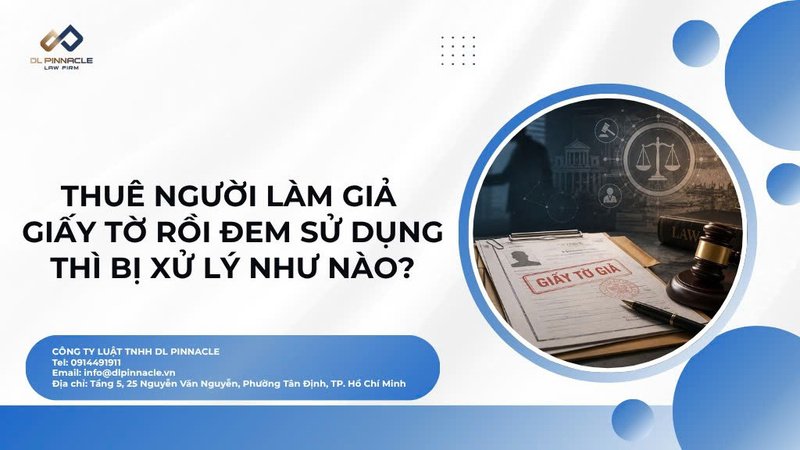
Hiring Others to Forge Documents and Using Them: Legal Liability and Judicial Guidelines Under Article 341
 Luật sư: Nguyễn Bá Tùng
 Cập nhật: 06:20, Thứ Sáu 04/09/2026
An expert legal analysis of administrative penalties under Decree 282/2025/ND-CP and criminal liabilities under Article 341 of the Criminal Code, guided by Official Dispatch 250/TANDTC-PC.
Index
1. What Constitutes a Forged Document?
2. Methods for Identifying Forged Documents
3. Legal Liabilities for Procuring and Using Forged Official Documents
3.1. Administrative Penalties:
4. Penalties for Concurrently Manufacturing and Using Forged Documents
Documents issued by competent authorities and organizations serve not only as instruments to record and verify legal facts and status, but also as the foundation for entities to exercise rights, fulfill obligations, and conduct transactions across socio-economic spheres. Consequently, ensuring the authenticity of official documents is an essential prerequisite for maintaining administrative governance and safeguarding legal certainty in society. In practice, however, there still exists the illicit manufacturing of documents and the utilization of forged documents to commit unlawful acts.
In practice, acts of document counterfeiting are executed through various methods. Parties seeking to deploy forged documents often do not fabricate them directly; instead, they hire, commission, or solicit third parties to perform the forgery before receiving and utilizing the counterfeit records. This creates significant legal issues concerning the determination of the conduct's substantive nature, the allocation of legal liabilities for parties hiring others to forge and subsequently using such documents, and the legal relationship between the act of forging documents and the act of using forged documents.
1. What Constitutes a Forged Document?
Prevailing law provides no rigid statutory definition of forged documents. However, forged documents can be understood as records unlawfully created to counterfeit documents legitimately issued or authenticated by competent state agencies or organizations. In evaluating whether a document is counterfeit, its origin and legal validity must be prioritized. A document is determined to be forged when it is not legitimately issued or certified by a competent authority or organization, but is intentionally manufactured to purport that it was issued, granted, or certified by such authority.
Commonly forged documents include: Certificates of Land Use Rights; Passports, Household Registration Books, Birth Certificates, Citizen Identity Cards, Marriage Certificates, Driver's Licenses, Vehicle Registration Certificates; Diplomas, Certificates, Transcripts; Loan Contracts, Property Lease Contracts, Sale and Purchase Agreements, Service Contracts; and Health Examination Certificates.
2. Methods for Identifying Forged Documents
The identification of forged documents typically relies on examining characteristics of paper blanks, signatures, official seals, substantive text, the stated issuing authority, and corroborating evidence. However, forensic analysis is essential in complex cases because counterfeit documents can closely replicate genuine instruments in form and content, making visual detection exceptionally difficult. Therefore, conclusive identification can only be achieved through forensic appraisal conducted by specialized authorities.
3. Legal Liabilities for Procuring and Using Forged Official Documents
The act of forging or utilizing forged documents of agencies and organizations erodes the transparency and validity of societal transactions, degrades public trust, and elevates the risk of secondary offenses. The harm extends beyond private damages to administrative order and public security.
Therefore, the act of hiring third parties to forge documents of agencies or organizations and subsequently utilizing them constitutes an unlawful violation. Depending on the nature and severity of the conduct, the procuring and using party shall face administrative sanctions or criminal prosecution, specifically:
3.1. Administrative Penalties:
Where hiring others to forge official documents and using them does not fully satisfy the constituent elements of a crime, administrative penalties apply to the act of utilizing forged documents, detailed as follows:
Individuals who utilize counterfeit Citizen Identity Cards, fake Identity Cards, forged Electronic Identity accounts, fake Identity Certificates, or falsified confirmation notices regarding canceled versus re-established personal identification numbers shall be fined from VND 8,000,000 to VND 10,000,000. For organizations committing the same violation, the applicable fine is doubled, specifically from VND 16,000,000 to VND 20,000,000.
Legal Basis: Clause 2, Article 5; Point a, Clause 4, Article 11 of Decree No. 282/2025/ND-CP dated October 30, 2025.
3.2. Criminal Prosecution:
In reality, many assume that paying others to forge documents makes them accomplices in a forgery syndicate, leading to prosecution for the Offense of forging seals or documents of agencies or organizations. Under legal analysis, determining a charge depends not only on subjective intent, but on the precise nature of the conduct and the specific role of each actor.
Pursuant to the guidance in Sub-item 8, Item I of Official Dispatch No. 250/TANDTC-PC dated April 28, 2026 of the Supreme People's Court: where an actor does not directly fabricate documents, but hires or solicits another person to execute the forgery and subsequently uses those forged documents to perform unlawful acts, such actor shall be criminally prosecuted for the Offense of using forged seals or documents of agencies or organizations under Article 341 of the 2015 Criminal Code (amended and supplemented in 2017) (provided all crime constituents are met), and shall not be charged with the Offense of forging seals or documents of agencies or organizations under Article 341 of the 2015 Criminal Code (amended and supplemented in 2017). The law clearly delineates the legal responsibilities of the manufacturer versus the user of forged instruments, avoiding improper consolidation into an identical charge.
Accordingly, an actor who hires others to forge documents and uses them to carry out unlawful acts faces criminal liability for the Offense of using forged seals or documents of agencies or organizations under Article 341 of the 2015 Criminal Code (amended and supplemented in 2017). Applicable statutory penalties include a fine ranging from VND 30,000,000 to VND 100,000,000, community sentence (non-custodial reform) for up to 03 years, or imprisonment up to 07 years. Offender may also face an additional fine from VND 5,000,000 to VND 50,000,000.
4. Penalties for Concurrently Manufacturing and Using Forged Documents
According to Sub-item 8, Item I of Official Dispatch No. 250/TANDTC-PC dated April 28, 2026 of the Supreme People's Court: if an actor directly manufactures forged documents and also uses those exact documents to carry out unlawful acts, they shall be prosecuted for both independent offenses: the Offense of forging seals or documents of agencies or organizations and the Offense of using forged seals or documents of agencies or organizations under Article 341 of the 2015 Criminal Code (amended and supplemented in 2017). Although codified within one statutory article, they remain two distinct legal crimes. Thus, the offender must be prosecuted for both offenses, receive corresponding penalties for each, and have them aggregated into a composite final sentence, rather than receiving a single penalty for both actions.
Accurate legal recognition of hiring third parties to forge documents and utilizing them is vital for determining liabilities, strengthening statutory awareness, curbing violations, and preserving state administrative order. In practice, coherent application of relevant statutes alongside granular assessment of roles, intent, and severity remains crucial to ensuring proper judicial determination.
| Information | Contact |
|---|---|
| Address | Floor 5, 25 Nguyen Van Nguyen, Tan Dinh Ward, Ho Chi Minh City |
| Hotline | 0914491911 |
| info@dlpinnacle.vn | |
| Website | https://www.dlpinnacle.vn |