
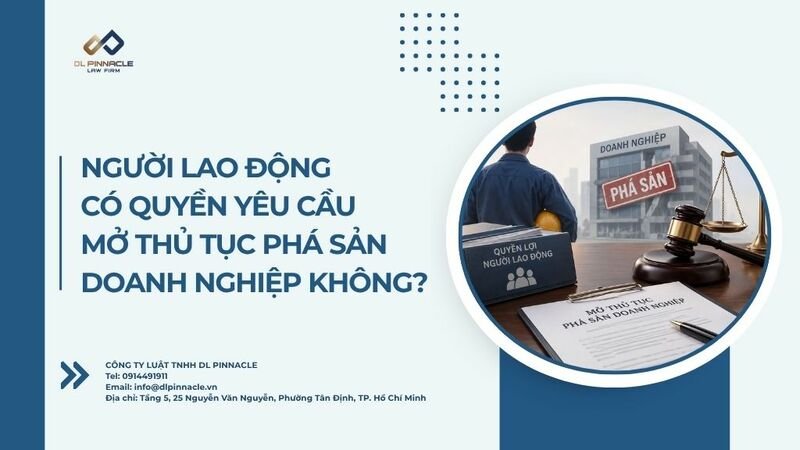
Do Employees Have the Right to Request Bankruptcy Proceedings Against an Enterprise?
An analysis of legal regulations regarding employees' rights to file for corporate bankruptcy upon employer insolvency, the 6-month overdue wage threshold, court jurisdiction, and required supporting dossiers.
1. Legal Significance of Commencing Corporate Bankruptcy Proceedings
2. When Is an Enterprise Deemed Insolvent?
3. Do Employees Have the Right to Petition for Corporate Bankruptcy?
4. Court Jurisdiction and Supporting Evidentiary Dossier
4.1. Competent Court Jurisdiction
4.2. Evidentiary Dossier Substantiating the Claim
Q&A: Practical Legal Inquiries on Employee Bankruptcy Petitions
Enterprises play a pivotal role in driving economic growth and generating employment opportunities. However, amid market volatility and business hurdles, not every enterprise can consistently maintain its capacity to settle financial obligations as they fall due. When a company falls into a state of insolvency, the legitimate rights and interests of relevant stakeholders—most notably employees—face severe risks.
In practice, workers frequently encounter unpaid wages, bonuses, overdue compulsory social insurance, and statutory allowances. This reality underscores the need for appropriate legal frameworks to protect employee interests when an employer becomes insolvent.
A central question that arises is: Do employees hold the legal standing to file a petition requesting bankruptcy proceedings against their employer? This is not only a matter of procedural statutory rights under insolvency laws, but also a core mechanism for safeguarding workers against the infringement of their financial entitlements when enterprises default on their liabilities.
1. Legal Significance of Commencing Corporate Bankruptcy Proceedings
Under Clause 2, Article 4 of the 2014 Law on Bankruptcy, bankruptcy is defined as the condition of an enterprise that has lost its solvency and is declared bankrupt by a People's Court. The commencement of bankruptcy procedures applies strictly to insolvent enterprises.
Pursuant to Clause 2, Article 42 of the 2025 Law on Rehabilitation and Bankruptcy, once a decision to open bankruptcy procedures has been rendered, the enterprise is strictly prohibited from engaging in the following activities:
- Concealing, dissipating, or gifting assets;
- Relinquishing claims for debt collection;
- Settling unsecured debts, except for unsecured debts arising after the commencement of bankruptcy proceedings and the payment of wages to employees within the enterprise;
- Converting unsecured debts into secured or partially secured debts backed by corporate assets;
- Distributing profits or declaring dividends.
Furthermore, according to Clause 1, Article 46 of the 2025 Law on Rehabilitation and Bankruptcy, once bankruptcy proceedings have been initiated, the enterprise's assets are distributed in the following statutory order of priority:
| Statutory Priority | Payable Financial Obligations |
|---|---|
| (1) | Bankruptcy expenses |
| (2) | Wage arrears owed to employees |
| (3) | Arrears for compulsory social insurance, unemployment insurance, health insurance, and occupational accident and disease insurance |
| (4) | Severance allowances and other statutory employee benefits under collective bargaining agreements and labor contracts |
| (5) | Debts incurred for the purpose of business rehabilitation |
| (6) | Financial obligations owed to the State |
| (7) | Unsecured debts payable to listed creditors; unpaid balances of secured debts where collateral value is insufficient to cover the liability |
Key legal roles of commencing bankruptcy proceedings:
- Ensuring a structured debt-resolution mechanism: Establishes an objective legal foundation to identify asset pools, verify liabilities, and execute asset distribution pursuant to statutory hierarchies.
- Safeguarding employee interests: Labor claims (wages, insurance contributions, and severance packages) are granted superior priority in the distribution order right after procedural expenses.
- Determining legal status and fostering recovery: Provides a structured window to explore business rehabilitation strategies or proceed with orderly liquidation under court supervision.
- Preventing asset dissipation: Forestalls fraudulent asset transfers, guarantees parity among creditors, and enhances asset recovery efficiency.
- Upholding commercial discipline: Enforces statutory consequences for default, promoting compliance and protecting bona fide participants in the marketplace.
2. When Is an Enterprise Deemed Insolvent?
An employer falling behind on its payments for a few days, weeks, or months does not automatically satisfy the statutory definition of insolvency. Identifying insolvency requires examining whether debt obligations remain overdue beyond the statutory duration.
According to Clause 2, Article 5 of the 2025 Law on Rehabilitation and Bankruptcy, an insolvent enterprise is an enterprise that fails to perform its debt payment obligation within 06 months from the due date.
Illustrative Example: Company A is obligated to pay salary to Ms. B (its employee) on October 10, 2026, but fails to do so. If by April 11, 2027 (past the 06-month threshold from the payment due date), Company A has still not settled the outstanding wage debt with Ms. B, sufficient grounds exist to determine that Company A has become insolvent.
3. Do Employees Have the Right to Petition for Corporate Bankruptcy?
Pursuant to Point b, Clause 1, Article 38 of the 2025 Law on Rehabilitation and Bankruptcy, employees possess the full statutory right to submit a petition for bankruptcy proceedings when:
A period of 06 months has expired from the date the enterprise was required to fulfill its obligation to pay salaries and other mature debts owed to employees, but failed to make payment.
An employee's right to petition is established upon the concurrent fulfillment of four elements:
- First: The existence of a financial obligation owed by the enterprise to the employee (wages or other debts arising from the employment relationship).
- Second: The payment obligation has become due and payable.
- Third: The enterprise defaulted on the mature obligation.
- Fourth: A duration of 06 months has elapsed since the due date without payment by the employer.
4. Court Jurisdiction and Supporting Evidentiary Dossier
4.1. Competent Court Jurisdiction
Pursuant to Point a, Clause 2, Article 6 of the 2025 Law on Rehabilitation and Bankruptcy, the Regional People’s Court where the enterprise has its head office possesses territorial jurisdiction to handle petitions requesting bankruptcy proceedings against that enterprise.
Employees must note: Do not file petitions at the court of your residential locality or physical work site. Petitions must be submitted to the competent People's Court governing the territory where the corporate debtor's headquarters are legally registered.
4.2. Evidentiary Dossier Substantiating the Claim
Under Clause 1, Article 39 of the 2025 Law on Rehabilitation and Bankruptcy, alongside the formal petition, the employee must submit a list of creditors and debtors (if known), accompanied by crucial documentary evidence:
- Proof of employment relationship: Employment contracts, hiring decisions, or official proof of appointment.
- Proof of outstanding wage obligations: Payroll sheets, timesheets, compensation agreements, or equivalent accounting records.
- Proof of payment maturity: Internal wage policies, payment notifications, or agreed salary schedules establishing the due date.
- Proof of default exceeding the statutory 06-month period: Written payment demands, debt reconciliations, internal work minutes, official email threads, or corporate correspondence confirming non-payment.
Q&A: Practical Legal Inquiries on Employee Bankruptcy Petitions
Question 1: The company has continuously delayed paying our wages, citing uncollected customer receivables. Do I need to wait until the company officially shuts down before filing a bankruptcy petition?
DL Pinnacle's Analysis: You do not need to wait for the company to cease operations. Under Point b, Clause 1, Article 38 of the 2025 Law on Rehabilitation and Bankruptcy, once 06 months have elapsed from the wage payment due date without settlement, you hold the complete legal right to submit a petition even if the business remains active. The company's internal financial hardship or cash flow constraints do not negate your statutory right to request bankruptcy proceedings.
Question 2: Our employer owes months of salaries and insurance contributions and shows signs of transferring company assets to third parties. Will filing a bankruptcy petition help prevent asset dissipation?
DL Pinnacle's Analysis: Yes, it serves as an effective statutory safeguard. Once the Court issues a decision to open bankruptcy proceedings, the enterprise is strictly prohibited by law from concealing, dissipating, or gifting assets, or waiving debt claims under Clause 2, Article 42. However, it is essential to distinguish the date of petition submission from the date the Court issues the opening decision; filing the petition does not automatically freeze assets until the Court formally grants the commencement order. Workers should preserve and present documentary proof of suspicious asset transfers to the Court to request interim relief.
Question 3: My company owes unpaid salaries and social insurance to staff, along with substantial debts to material suppliers. If the Court opens bankruptcy proceedings, must employee salaries be paid first?
DL Pinnacle's Analysis: Under Clause 1, Article 46 of the 2025 Law on Rehabilitation and Bankruptcy, immediately following procedural bankruptcy costs, salary debts are given first priority for settlement, followed by compulsory insurance debts and severance allowances. Trade suppliers (typically unsecured creditors) are ranked lower in the payment hierarchy. However, the priority order does not guarantee a full 100% recovery, as ultimate reimbursement remains contingent upon the liquidated value of the debtor's remaining asset pool.
Contact Information
| Information | Contact |
|---|---|
| Firm | DL PINNACLE LAW FIRM LLC |
| Address | 5th Floor, 25 Nguyen Van Nguyen, Tan Dinh Ward, Ho Chi Minh City |
| Hotline | 0914491911 |
| info@dlpinnacle.vn | |
| Website | https://www.dlpinnacle.vn |
The information provided in this article is for general informational purposes only. For specific legal advice suited to your situation, please contact DL Pinnacle attorneys directly.