Defamation and Slander in Closed Chat Groups: Legal Boundaries and Associated Liabilities
Legal analysis of statements in private chat groups under Article 34 of the Civil Code, Decree 174/2026/ND-CP, crimes of insult and slander, and the evidentiary value of screenshots.
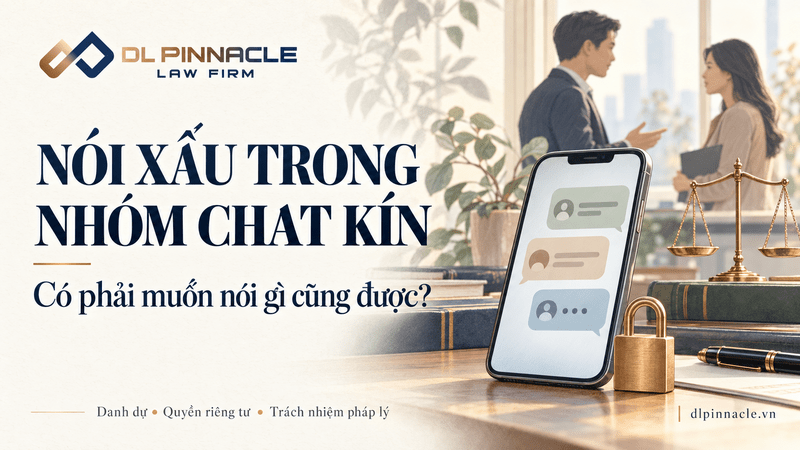
Defamation in Closed Chat Groups: Can You Say Whatever You Want?
1. “Defamation” Is an Everyday Term, Not a Formal Legal Conclusion
2. A Closed Chat Group Does Not Constitute Grounds for Exemption from Liability
3. Potential Civil, Administrative, or Criminal Liabilities
4. The Author and the Distributor Must Be Evaluated Independently
5. Screenshots Are the Starting Point of Verification, Not the Whole Story
6. Three Common Misconceptions Among Social Media Users
7. Protecting Yourself: Evidence Preservation and Lawful Responses
Defamation in Closed Chat Groups: Can You Say Whatever You Want?
Lawyer Nguyen Ba Tung — DL Pinnacle Law Firm LLC
Many disputes arise when the honor, dignity, and reputation of an individual are infringed upon within closed chat groups. While a closed group creates a sense of privacy, it does not eliminate legal liability for statements that negatively impact others. An unfavorable or unkind remark is not in itself sufficient to conclude that the author has violated the law. However, where there are sufficient grounds to evaluate the content, context, evidence, and actual conduct, the individual concerned must bear statutory liability for defamatory statements made within a private group.
A complaint shared among colleagues, a critical remark exchanged between friends, and soon a screenshot surfaces on public social media. Through just a few forwards, a conversation originally restricted to a small circle can become a matter of public debate involving thousands of people.
When this occurs, two common arguments typically emerge:
- The author contends that they were merely having a private conversation in an internal context.
- The person who shared or published the screenshot claims that because the content is true, they have the right to make it public.
From a legal perspective, both arguments require rigorous and cautious examination.
1. “Defamation” Is an Everyday Term, Not a Formal Legal Conclusion
In daily life, "defamation" or "bad-mouthing" can refer to an unfavorable remark or an indelicate critique, but it can also encompass fabrication or the severe humiliation of another person. Such statements cannot be evaluated indiscriminately. At a minor level that causes no legally actionable harm, the parties may resolve the issue through mutual apology and retraction; however, at more severe levels, the publisher or speaker may face formal legal sanctions.
Illustrative Example: The observation "I find A's work coordination inadequate" differs fundamentally in its legal nature from knowingly spreading a false accusation that "A has embezzled company funds". To establish legal liability, competent authorities must examine what was actually stated, on what grounds, and within what specific context.
Article 34 of the 2015 Civil Code protects the honor, dignity, and reputation of individuals. This right does not transform every critique into an unlawful act. Legitimate criticism grounded in factual reality and made for appropriate purposes must be clearly distinguished from acts of personal harassment, insult, or the dissemination of false information. A proper, objective assessment requires evaluating:
- The actual substance of the statement and its surrounding context.
- Whether the subject being referred to is identifiable.
- The subjective fault of the speaker.
- The degree of infringement, actual harm caused, and relevant statutory conditions.
2. A Closed Chat Group Does Not Constitute Grounds for Exemption from Liability
Restricting membership is a factor to be considered when evaluating the scope of communication and the extent of impact; however, it cannot be inferred that any and all statements within a closed group are legally permissible.
Pursuant to Point g, Clause 3, Article 96 of Decree 174/2026/ND-CP (effective July 1, 2026), administrative sanctions apply to acts of providing, exchanging, or utilizing digital information to threaten, harass, distort, slander, or insult the honor, dignity, and reputation of others within the statutory scope of the provision. Consequently, the "closed" nature of a chat group does not automatically exclude the application of legal sanctions.
Conversely, competent authorities cannot simply take an unseemly remark and immediately impose sanctions. The authorized agency must establish the full elements of the violation and statutory conditions, rather than inferring liability based on public outrage on the internet.
3. Potential Civil, Administrative, or Criminal Liabilities
Each legal liability mechanism operates under distinct statutory thresholds; an act is not automatically subject to every sanction merely because it is labeled as "defamation":
- Civil Liability: The aggrieved individual whose honor, dignity, or reputation has been infringed may request judicial protection under Article 34 of the 2015 Civil Code, including requests to refute false statements, make a public apology, issue a rectification, and pay statutory damages.
- Administrative Liability: Using digital communications to insult, slander, or unlawfully disclose private information may fall under the sanctionable provisions of Points g and m, Clause 3, Article 96 of Decree 174/2026/ND-CP.
- Criminal Liability: When the constitutive elements of a crime are satisfied, the conduct may be examined under Article 155 (Crime of Insulting Another Person) or Article 156 (Crime of Slander) of the Penal Code.
It is essential to note the requirement of severity in the crime of insulting another person. Under Point a, Clause 1, Article 156 (Slander), the inquiry extends beyond false statements to encompass fabricating or disseminating matters known to be false, coupled with the specific unlawful purpose defined by law.
Therefore, "unpleasant remarks", "untrue information", and "criminal offenses" are distinct legal concepts that cannot be conflated. Any assessment must be founded on verifiable evidence and statutory elements, rather than social media metrics or share counts.
4. The Author and the Distributor Must Be Evaluated Independently
An individual may bear liability for the content they generate, whereas another party may be liable for the way they collected, edited, or publicized that content. The law does not automatically bundle these acts together.
Article 38 of the 2015 Civil Code protects private life, personal secrets, family secrets, and the confidentiality of private correspondence and communication. Collecting, storing, using, or disclosing such protected information requires the consent of the parties involved, subject to exceptions prescribed by law.
- Being a member of a private chat group does not confer the absolute right to disclose another member's statements to the general public.
- The authenticity of a message does not automatically answer whether the republisher has the lawful right to make it public.
- Submitting relevant correspondence to competent state authorities for dispute resolution constitutes a legitimate procedural action, which differs fundamentally from posting screenshots online to instigate collective harassment.
5. Screenshots Are the Starting Point of Verification, Not the Whole Story
A screenshot of a message can serve as preliminary evidentiary material. However, an excerpt isolated from an ongoing conversation easily obscures prior context, subsequent clarifications, or the speaker's true intent.
To ensure an objective and credible assessment, authorities and legal practitioners must clarify at least the following elements:
- Identity Verification: Have the sending account and the actual user operating the device been conclusively identified?
- Integrity of Content: Has the text or image been altered, cropped, selectively edited, or stripped of essential context?
- Nature of the Act: Was the message authored directly by the sender, forwarded, or merely quoted from a third party?
- Distribution Chain: Who leaked the content outside the group, and did the original author participate in or direct that dissemination?
- Actual Impact: Who was targeted, what was the actual audience reach, and what verifiable damages resulted?
Liability for widespread dissemination cannot be imputed to the author without proving their specific conduct, fault, and causation. Concurrently, those who republish or share content cannot claim complete immunity merely because they were not the initial author.
6. Three Common Misconceptions Among Social Media Users
- "Not naming the person means no violation?": The law does not rely exclusively on whether a full name is explicitly stated. If contextual details, job descriptions, or imagery enable third parties to unambiguously identify the individual, unlawful infringement may still be established.
- "If the information is true, I have the right to post it?": The veracity of information is one issue; the right to privacy and protection of personal secrets is an entirely distinct legal entitlement. Publicizing truthful information may still constitute a legal violation if it breaches protected privacy rights without statutory grounds.
- "I only forwarded it, so I am not responsible?": Forwarding a message introduces the content to a new recipient or audience. Liability, if any, is assessed based on the nature of the information, the sender's knowledge, purpose, and statutory standards; one cannot rely solely on the defense of "I didn't write it".
7. Protecting Yourself: Evidence Preservation and Lawful Responses
If you become the target of defamatory or inaccurate content within a group, the first step is to remain calm and lawfully preserve relevant records:
- Preserve Digital Evidence and Bailiff Deeds: Promptly request a Bailiff (Thừa phát lại) to record the digital evidence (links, timestamps, source profiles, and message threads) before messages are unsent, edited, or deleted.
- Document Harm: Compile evidence showing concrete damage to personal reputation, mental distress, or disruption to business and professional activities.
- Pursue Appropriate Legal Remedies: Depending on the severity, you may demand cessation, removal, public apologies, and retractions; request platform intervention; or submit formal petitions and complaints to police authorities and competent Courts.
For participants and group administrators, the core operating standard is to communicate based on verified facts, keep discussions aligned with legitimate purposes, and refrain from abusive language. Before hitting send, consider: Has this information been verified? Is it necessary for the discussion? Does it infringe upon the lawful rights of others?
8. Free Expression Must Coexist with Legal Respect
A private chat group needs room for diverse viewpoints, including uncomfortable criticisms. However, that space must function on the foundation of respect for the honor and private life of all involved. Not every interpersonal dispute should be escalated into a legal battle, but the label of a "closed group" must never be treated as an absolute shield against statutory accountability.
A message carefully considered before sending can prevent extensive legal disputes later.
Contact Information
| Information | Contact Details |
|---|---|
| Consulting Firm | DL PINNACLE LAW FIRM LLC |
| Address | Floor 5, 25 Nguyen Van Nguyen, Tan Dinh Ward, Ho Chi Minh City |
| Hotline | 0914491911 |
| info@dlpinnacle.vn | |
| Website | https://www.dlpinnacle.vn |
The information provided in this article is for general informational purposes only. For specific legal advice suited to your situation, please contact DL Pinnacle attorneys directly.